

2084 Election: A Test of Nepal’s Democratic Maturity
Amit Khanal

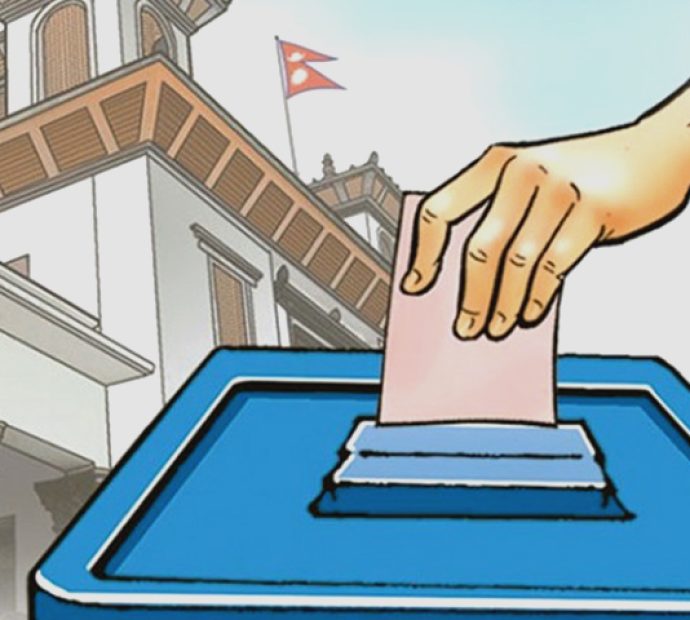
As Nepal inches closer to the general election of 2084 B.S., the stakes have never been higher.
While elections are often celebrated as the lifeblood of democracy, in Nepal they have increasingly become tools of manipulation ritualistic exercises that recycle the same actors, preserve dysfunctional institutions, and suppress transformative politics.
If we, as citizens, are not sharply critical and consciously engaged, this election will only cement our descent into a broken system disguised as democracy.
The Crisis of Representation and Repetition
Despite repeated promises, Nepal’s political system continues to suffer from a crisis of representation. The same handful of leaders and elite families have dominated the landscape for decades, reshuffling themselves between parties, ministries, and factions.
What we are witnessing is not a competition of visions, but a closed cartel of power brokers who’ve turned politics into a self-serving enterprise. If citizens don’t critically evaluate this structure and challenge the cycle of elite reproduction, elections will only reproduce failure.
Nepal’s voters must ask:
Why has real federalism failed to empower local governments?
Why are youth, women, Dalits, Janajatis, and Madhesis still structurally marginalized in the very system that claims to be inclusive?
Why has no major political party fulfilled its constitutional promises, yet continues to win votes with empty slogans?
From Electoral Democracy to Clientelist Capture
Nepal is now a textbook case of clientelist democracy where votes are not cast based on policy or ideology, but in exchange for favors, temporary relief, caste loyalty, or local patronage. This is dangerous. It transforms citizens into clients, not rights-holding stakeholders.
The 2084 election must be seen as a battle to restore the soul of democracy, where votes are cast based on policy clarity, ethical governance, and long-term nation-building, not shallow populism or personal proximity.
A Rotten System of Corruption and Extraction
From fake cooperatives to corruption in medical education, road contracts, and land registration, every sector has been captured by corrupt syndicates, often backed by politicians. Corruption is not just a “flaw” in the system it is the system. Without a critical mass of voters willing to reject corrupt candidates regardless of party loyalty, this rot will deepen.
The upcoming election is a referendum on how much corruption we are willing to normalize.
Ask yourself:
Why do our public schools and hospitals continue to crumble despite decades of budgets?
Why are natural resources like hydropower and land being monopolized by a few powerful families?
Who really benefits from “development” projects: the people, or the party-linked contractors?
Voters Must Outgrow the Culture of Blind Loyalty
Partisan culture in Nepal is dangerously tribal. Many voters still vote based on caste, region, or family legacy even when their representatives have failed them for years. Critical thinking has been replaced by party fanaticism. Media has either become commercialized or captured by political actors, and social media is flooded with misinformation, fake nationalism, and conspiracy theories.
We must create a new culture of evidence-based voting, where:
Policy debates matter more than personalities.
Track record matters more than rhetoric.
National interest outweighs party interest.
What Kind of Nepal Do We Want?
The deeper question is not just who should win the 2084 election but what kind of nation we want to build.
Do we want:
A state that continues to export its youth and import remittance, or a self-reliant economy that generates decent jobs at home?
A nation where environmental destruction is packaged as development, or one that protects rivers, forests, and indigenous knowledge?
A political system that rewards brokers and betrayers, or one that values ethical leadership and public service?
These questions cannot be left to political parties alone. The burden is on us the voters. If we fail to demand transformative agendas, if we settle for “lesser evil,” if we remain silent in the face of injustice we are complicit in our own exploitation.
The 2084 Election Is a Tipping Point
Nepal stands at a civilizational crossroad. Will we use this election to reset the system reclaim democracy, revive hope, and restructure the state? Or will we continue down the road of cynicism, decay, and authoritarian temptation masked in populist robes?
Let us be clear: Nepal does not lack resources, ideas, or youth energy. What we lack is a courageous electorate willing to rise above identity politics and fight for a better future.
In 2084, we must not just elect new leaders.
We must elect a new political consciousness.
And that begins with being brutally honest, deeply critical, and courageously hopeful.
 Rupee Exchange Rate