

The Double-Edged Sword of Social Media Regulation
Amit Khanal
The rapid rise of social media has transformed how we communicate, share ideas, and engage with the world. Platforms like X, Facebook, and others have become virtual public squares, amplifying voices and connecting billions. However, this digital revolution has a darker side: cybercrime, data breaches, and cyberbullying are escalating at an alarming rate.
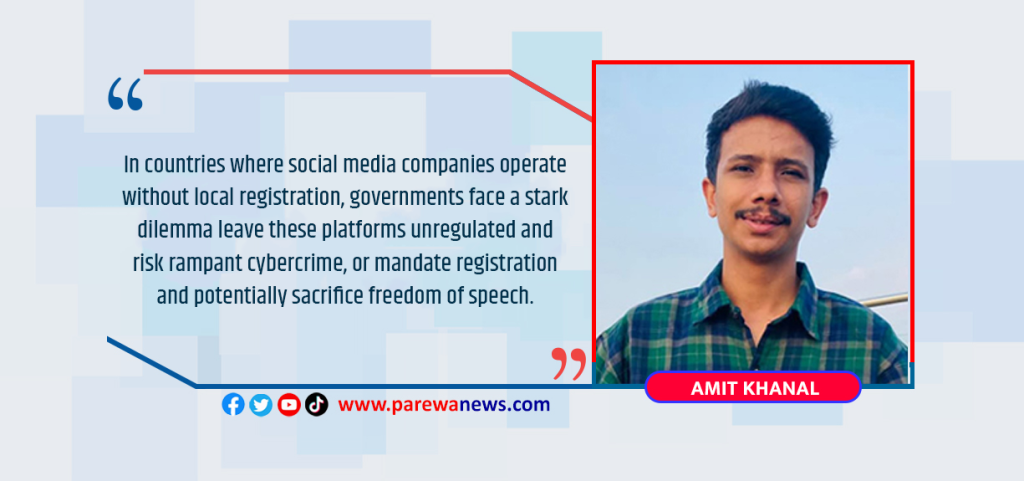
In countries where social media companies operate without local registration, governments face a stark dilemma leave these platforms unregulated and risk rampant cybercrime, or mandate registration and potentially sacrifice freedom of speech. This column explores the complexities of this issue, critically examining the trade-offs between data security, individual liberties, and government control.
The Case for Regulation: Tackling Cybercrime and Data Security
The absence of local registration for social media platforms creates a regulatory vacuum that emboldens cybercriminals. Without a legal presence in a country, these companies often operate beyond the reach of local law enforcement, making it difficult to address issues like data theft, online harassment, or the spread of illegal content. For instance, when a user falls victim to a data breach or cyberbullying, authorities often lack the jurisdiction to compel foreign-based companies to cooperate swiftly or meaningfully. This leaves victims vulnerable, with little recourse against perpetrators who exploit the anonymity of the internet.
Moreover, unregistered platforms often fail to comply with local data protection laws, if they exist. In many countries, personal data is mishandled or stored on servers abroad, where it’s subject to foreign laws or no laws at all. The 2021 Facebook data breach, which exposed the personal information of over 500 million users worldwide, underscored the risks of lax oversight. In nations without registered entities, governments have no leverage to enforce accountability or impose penalties, leaving citizens exposed to identity theft, fraud, and other cybercrimes.
Requiring social media companies to register locally could address these issues. A legal presence would force platforms to adhere to national data protection regulations, cooperate with law enforcement, and invest in robust cybersecurity measures tailored to local needs. For example, the European Union’s GDPR has set a global standard for data privacy, compelling companies to prioritize user security or face hefty fines. Local registration could similarly empower governments to hold platforms accountable, reducing the incidence of cybercrime and fostering trust in digital spaces.
The Threat to Freedom of Speech
However, the push for registration is not without significant risks. When social media companies are required to establish a legal presence, governments gain greater control over their operations, which can lead to overreach. Authoritarian regimes, in particular, may exploit registration requirements to suppress dissent and curtail freedom of speech. By mandating compliance with local laws, governments can pressure platforms to censor content deemed “undesirable” or to share user data with authorities, undermining privacy and free expression.
Take the case of China, where strict registration and compliance laws have enabled the government to create a tightly controlled digital ecosystem. Platforms like WeChat operate under constant state surveillance, with content moderated to align with government narratives. In countries with weaker democratic institutions, local registration could similarly enable governments to weaponize vague laws such as those targeting “hate speech” or “misinformation” to silence critics or minority voices. Even in democracies, the line between regulation and censorship is thin. For instance, India’s 2021 IT Rules, which require social media companies to appoint local compliance officers, have raised concerns about government overreach, with critics arguing that they give authorities undue power to remove content or access user data.
The chilling effect of such measures is real. When platforms face the threat of fines, bans, or legal action, they may preemptively censor content to avoid conflict, even if it stifles legitimate speech. This self-censorship can erode the open discourse that social media platforms were designed to foster, transforming them into tools of state control rather than spaces for free expression.
The Vicious Cycle of Inaction
Failing to regulate social media companies, however, perpetuates a vicious cycle of cybercrime and mistrust. Without local oversight, platforms have little incentive to prioritize the safety of users in smaller or less influential markets. Cyberbullying, for instance, thrives in environments where platforms face no consequences for inaction. Studies estimate that 40% of teenagers worldwide have experienced some form of online harassment, yet platforms often rely on automated moderation systems that fail to address nuanced or context-specific abuse. This lack of accountability fuels public frustration and erodes trust in both the platforms and the governments that fail to regulate them.
Furthermore, the absence of regulation exacerbates the spread of misinformation and illegal content, which can have devastating real-world consequences. From incitement to violence to the proliferation of deepfakes, unregulated platforms can amplify harm at an unprecedented scale. In countries where social media companies operate without local accountability, governments are left scrambling to address these issues with limited tools, often resorting to blunt measures like internet shutdowns or outright bans neither of which solves the root problem.
Striking a Balance: A Path Forward
The tension between securing data and preserving freedom of speech demands a nuanced approach. Governments must resist the temptation to use registration as a pretext for control while ensuring that platforms are held accountable for protecting users. A balanced framework could include the following principles:
Transparent Data Protection Laws: Governments should enact clear, enforceable data protection regulations that require platforms to safeguard user data without compromising privacy. These laws must be specific, avoiding vague language that could be exploited to justify censorship.
Independent Oversight: To prevent government overreach, an independent regulatory body should oversee compliance, ensuring that platforms adhere to data security standards while protecting freedom of speech. This body could mediate disputes between platforms, users, and authorities, fostering accountability without enabling state control.
Proportional Enforcement: Penalties for non-compliance should be proportionate and focused on user safety, not political agendas. For example, fines for data breaches or failure to address cyberbullying should incentivize better practices without pushing platforms to over-censor.
Global Collaboration: Cybercrime and data security are global issues that require international cooperation. Countries should work together to establish baseline standards for social media regulation, preventing companies from exploiting jurisdictional gaps.
Ultimately, the goal is to create a digital ecosystem where users are protected from harm without sacrificing their right to speak freely. This requires governments, platforms, and civil society to engage in open dialogue, acknowledging the legitimate concerns on both sides. Ignoring the issue will only deepen the divide, leaving us caught between the twin threats of cybercrime and censorship.
Conclusion
The debate over social media regulation is a microcosm of the broader challenge of governing the digital age. On one hand, local registration could empower governments to combat cybercrime and protect user data, addressing the growing threat of online harm. On the other, it risks handing authorities a tool to suppress dissent and erode the very freedoms that make social media valuable. The path forward lies in striking a delicate balance one that holds platforms accountable while safeguarding the open, democratic potential of the internet. Without careful consideration, we risk either a lawless digital frontier or a tightly controlled one, both of which come at a steep cost.














 Rupee Exchange Rate